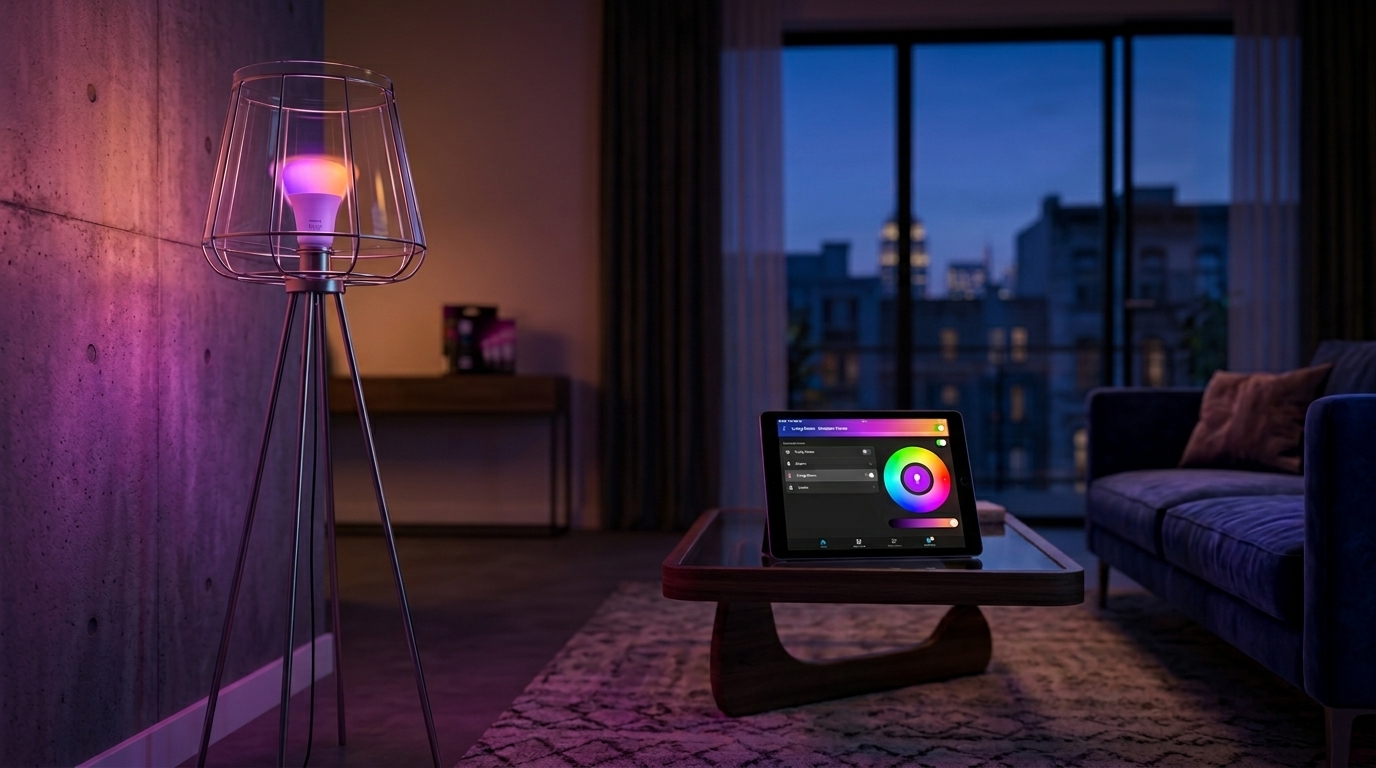
Welcome to affilore.com’s definitive Philips Hue A19 review 2026. If you are building a resilient, high-performance smart home lighting setup, you have undoubtedly encountered the Philips Hue ecosystem. While the market is flooded with budget-friendly Wi-Fi bulbs and emerging Matter-over-Thread alternatives, Philips Hue maintains its position as the premium standard.
However, getting the most out of these 60W A19 White and Color Ambiance bulbs requires looking past the marketing jargon. In this review, we will dissect the long-term reliability, 'pro' automation capabilities, and the critical architectural decisions you need to make when investing in the Hue ecosystem.
Design, Build Quality, and Hardware Evolution
If you are a long-time smart home enthusiast upgrading older Hue hardware, you will notice a distinct change in the physical design of the latest A19 bulbs. Previous iterations of the Hue A19 featured heavy, glass enclosures, whereas the modern models utilize a lighter plastic dome. While this transition to plastic was likely a cost-cutting measure by Philips, the overall dimensions remain slightly larger and heavier than a traditional "dumb" lightbulb due to the internal Zigbee radios and LED circuitry. Fortunately, they still fit seamlessly into any standard light socket.
In terms of longevity, these bulbs are built to endure. Long-term users report heavy, daily usage lasting around five years before the internal circuitry—rather than the LED diodes themselves—begins to fail or pulsate. For a smart device subjected to constant thermal cycles, this is an impressive lifespan.
Performance: The Zigbee Advantage and Pro Automation
The true superiority of the Philips Hue ecosystem lies in its underlying protocol: Zigbee. When building a comprehensive smart home lighting setup, network congestion is a primary concern. Users relying on direct-to-Wi-Fi bulbs often find that deploying 30 or more smart lights can cripple an ultra-fast home network, as the bulbs constantly chatter and search for optimal signal strength.
Philips Hue circumvents this by utilizing a Zigbee coordinator (such as the Hue Hub/Bridge) to handle all device communication, leaving your standard 2.4GHz Wi-Fi band completely clear. This results in instant response times, highly reliable scene executions, and a system that scales beautifully across massive properties.
For the "pro" automation crowd, the Hue A19 is incredibly versatile. You do not even strictly need the proprietary Hue Hub. Advanced users can pair these bulbs directly to an open-source Zigbee coordinator via Home Assistant. The pairing process is remarkably fast: simply put the controller into pairing mode, apply power to the bulb, and it is interviewed and added to your dashboard in seconds. Once integrated into a pro system like Home Assistant, you have granular control over 16 million colors, daylight temperature sweeping (from a warm 2000K to a crisp 6500K daylight), and complex color loop automations.
The Power Outage Quirk
Before deploying these bulbs in every bedroom, you must be aware of a deliberate, yet controversial, design choice: their default power-cycle state. If your home loses power during a storm and the electricity flickers back on, Philips Hue bulbs are designed to turn on at 100% maximum brightness—even if they were previously turned off or set to a dim red.
This feature exists so that users can physically flip a traditional light switch off and on to force the lights to illuminate without needing an app. However, if a thunderstorm hits at 2:00 AM, a brief power flicker will instantly flood your bedroom with blinding light. While these bulbs are incredible for simulating morning sunrise alarms, animating from dark red to orange and white, the power outage quirk has driven some users to return them entirely.
Unmatched Low-Level Dimming
Where the Philips Hue A19 completely destroys the competition is at the bottom end of the brightness spectrum. If you require soft lighting for nighttime navigation, these bulbs can dim down to an ultra-low 0.2%. Many competing smart bulbs flicker or shut off entirely before reaching this level. This ultra-low threshold makes the Hue A19 the absolute best choice for subtle ambient lighting, late-night hallway illumination, and bedroom nightlights.
The Brutal Truth
To give you the complete picture for 2026, we need to address the hard realities of the current smart lighting landscape. The smart home industry is evolving rapidly, and Philips Hue is navigating several complex transitions.
The Matter Reality
If you are searching for the best smart bulbs for Matter, you need to tread carefully. Matter was promised as the ultimate unifying standard for smart homes, but the rollout has been rocky. As of April 2026, a "Matter meltdown" caused widespread connectivity losses and "No Response" errors between the Philips Hue ecosystem and Apple Home due to integration bugs. To resolve this, users must immediately update their systems to Firmware version 2071294010.
Because of these growing pains, the proprietary Hue Bridge remains vastly safer, faster, and more reliable than attempting a direct Matter-over-Thread setup with experimental third-party hardware. The Bridge acts as a protective buffer, translating Hue's rock-solid Zigbee network into your smart home platform of choice. Until Matter matures completely, sticking to the standard Bridge integration is the path of least resistance for a stable home.
Lumen Wars: Philips Hue vs Nanoleaf Essentials
When comparing Philips Hue vs Nanoleaf Essentials, you have to look at raw output versus lighting quality. The Philips Hue A19 maxes out at 810 lumens. By contrast, the Nanoleaf Essentials push a significantly brighter 1,100 lumens.
If your goal is task lighting—such as illuminating a dark, windowless garage or a detailed workbench—the 810 lumens of the Hue A19 will feel like a bottleneck. However, raw brightness is not the whole story. As you mentioned regarding 'Chromasync' style color matching, the sources confirm that Philips Hue is engineered specifically for ambiance, smooth transitions, and absolute color precision. If you are matching on-screen movie colors, creating immersive gaming scenes, or dialing in specific architectural accents, Hue's color rendering and immediate responsiveness are superior. Simply put: buy Nanoleaf for raw brightness, but buy Hue for perfect atmospheric control.
The Bridge Pro Divide
In 2026, Philips introduced a new hardware tier that forces consumers to make a choice: the standard Hue Bridge versus the new Bridge Pro.
When do you actually need to spend the extra money on the Pro model? It comes down to the scale of your automation. If you are outfitting a small apartment with under 50 lights, the standard Bridge is perfectly adequate. However, if you are building a full, comprehensive smart home with extensive indoor and outdoor lighting, the Bridge Pro is now mandatory. The Pro hub supports 150+ light points and unlocks advanced processing features like MotionAware™, a new technology that utilizes the RF signals of the bulbs themselves to act as presence and motion sensors. If you want true 'pro' automation without buying dozens of standalone PIR motion sensors, the Bridge Pro is the required upgrade.
Pricing and Final Verdict: The "Luxury Tax"
There is no getting around it: Philips Hue is expensive. A single color A19 bulb often costs more than an entire 4-pack from budget competitors like Govee.
However, treating Hue as a budget-friendly starter kit is the wrong approach; this is a "Buy it Once" investment. You are paying a "luxury tax" for unparalleled stability, a completely local Zigbee network that won't destroy your Wi-Fi router, and a product that scales natively to hundreds of devices without latency.
At full retail price, it can be a tough pill to swallow, which is why veteran smart home builders heavily recommend buying them used, open-box, or during major sales events like Prime Day or Black Friday, where starter kits can sometimes be snagged for as low as $12.49 a bulb.
If you value the ability to drop a light to 0.2% brightness, want flawless color accuracy, and demand a network that simply works every time you press a button, the Philips Hue A19 White and Color Ambiance remains the undisputed king of smart lighting.
Ready to elevate your smart home?
The ultimate lighting ecosystem is just a click away.
🛒 Check Price on Amazon →
As an Amazon Associate, we earn from qualifying purchases.